Chinese conservationists are in a fix over endangered condors eating large numbers of a protected species of deer in a reserve in the north of the country.
More than 100 young spotted deer have been eaten by the condors so far this spring at the Luanhe River National Nature Reserve in Hebei province, near Beijing,becoming an "unanticipated" part of the food chain.
Nationally, the condor is considered far more endangered than the deer.
"The raptors are growing in number and threatening to catch larger animals, like elk, in the reserve," it quoted wildlife official Zhou Changhong as saying.
The reserve only has 600 or so deer and just 10 elk, the report added.
"An adult condor has a wingspan of more than two metres, and not even wardens can frighten it," Zhou said.
Source
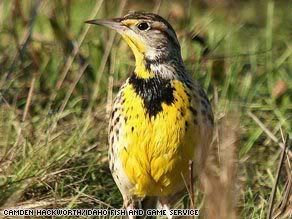 Just as they were when Rachel Carson published 'Silent Spring' nearly 50 years ago, birds today are a bellwether of the health of land, water and ecosystems.
From shorebirds in New England to warblers in Michigan to songbirds in Hawaii, we are seeing disturbing downward population trends that should set off environmental alarm bells.
The declines can be traced to a variety of factors, depending on a bird's particular habitat. But the causes most frequently cited in the report are agriculture, climate change, development and energy, and invasive species.
Source
 Eden TV, a new UK-based natural history TV channel has recently begun broadcasting. To celebrate their launch, the network built a 16-foot-high sculpture of a mother polar bear and her cub stranded on an iceberg. Also meant to increase awareness about the plight of the polar bear and their dwindling habitat as a result of climate change, the sculpture was sent to float down the Thames river.
Read more ...
(via Inhabitat)
A collection of 13 species seriously in danger of becoming extinct in the wild, all with babies born in captivity in the past few years.
(via Look at This)
(via Look at This)
By some estimates, Borneo's vast forests are being cleared faster than the Amazon. Unless something is done now, Orangutans could be extinct in 20 years.
The practice of bulldozing everything to make way for palm oil plantations has left Orang-utans without their customary habitat.
Lone Droescher-Nieslen from the Orangutan Survival Foundation hopes she can rehabilitate the Orangutans back into the wild. But if the rate of deforestation continues, there may soon be no forests to release them into...
Watch the video
The practice of bulldozing everything to make way for palm oil plantations has left Orang-utans without their customary habitat.
Lone Droescher-Nieslen from the Orangutan Survival Foundation hopes she can rehabilitate the Orangutans back into the wild. But if the rate of deforestation continues, there may soon be no forests to release them into...
Watch the video
Animal Planet has created a great website, The Animals Save the Planet. It has animated shorts, fun downloads, and suggestions on saving the Earth.
My favorite is the farting cow, Stanley, who teaches that livestock is responsible for 18% of total greenhouse gas emissions.

Stanley suggests saving the planet by eating less meat. Well, of course he would say that, duh!
If you like Stanley too, you can download a Farting Cow widget.
My favorite is the farting cow, Stanley, who teaches that livestock is responsible for 18% of total greenhouse gas emissions.
Stanley suggests saving the planet by eating less meat. Well, of course he would say that, duh!
If you like Stanley too, you can download a Farting Cow widget.
 Whooping cranes have waged a valiant fight against extinction, but federal officials warn of a new potential threat to the endangered birds: wind farms.
Down to about 15 in 1941, the gargantuan birds that migrate each fall from Canada to Texas now number 266, thanks to conservation efforts.
But because wind energy has gained such traction, whooping cranes could again be at risk - either from crashing into the towering wind turbines and transmission lines or because of habitat lost to the wind farms.
"Companies want to put their farms where the best wind is, and that overlaps with the migration corridor of the whooping crane," Tom Stehn, the whooping crane coordinator of the US Fish and Wildlife Service
Source: AZ Central
Photo: Texas Parks and Wildlife
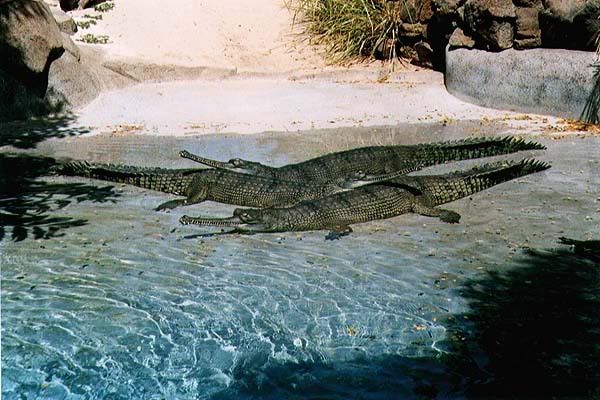 Three decades after it was brought back from the brink of extinction, the rare Indian crocodile known as the gharial is turning up dead by the dozens on the banks of a river called the Chambal. Forest officials are at a loss to explain why.
Since mid-December, the National Chambal Wildlife Sanctuary has confirmed 76 deaths along the river, which begins in the central Indian state of Madhya Pradesh and runs through Rajasthan and Uttar Pradesh.
Other species that inhabit the Chambal River ecosystem, including dozens of fish species on which the gharials feed, appear to be healthy.
Sourge: NY Times
Photo: Tim Dwight(Wildldife Web)
 Across the dry grasslands of California's valleys and foothills, goats are gaining recognition as an effective weapon to cut the risk of rampaging wildfires and to check the spread of nonnative weeds such as star thistle.
Goats don't have the drawbacks of chemical sprays, and they have a sweet tooth for weeds and other noxious plants that other grazing animals shun, say boosters of the practice.
Between bouts of jumping into the air and butting heads, the young goats swarm through the weeds, grazing on dry grass, chewing the bark of manzanita trees and reaching high on two legs to munch on the leaves of taller trees.
The 49 adult goats and 30 youngsters belong to Dave Cheney, who has operated Pine Ridge Goats since 2001.
Cheney trucks the animals into an area to be cleared, sets up a temporary electric fence, arms it with a truck battery and puts the goats to work on the weeds.
His goats are Kikos, a hardy breed developed in New Zealand. Beyond what they eat on their own, they get a dessert of farm-grown hay at the end of the day, when he uses it to entice the goats into their pens.