Along the Chicago lakefront, gizzard shad - a type of herring — are dying off in large numbers. Thousands, maybe more, are dead and frozen or floating in Lake Michigan. Geese and ducks are feeding on the dead and dying fish.

Gizzard shad, members of the herring family, are more sensitive to drops in oxygen levels than most fish. And thick ice came early to Chicago harbors in December.
PHOTO: Dale Bowman~For the Sun-Times
Source

Photograph by Michael McEvoy, DEEP Indonesia/Barcroft/Fame Pictures
A close-up of a blue-eyed moray eel in Indonesia captured an honorable mention in the "Indonesia Residents" category of the fourth annual Deep Indonesia International Underwater Photo Competition, whose winning photos were released to the press earlier this month.
Known to grow as long as about 5 feet (1.5 meters), moray species generally lack pectoral fins, unlike most other eel species.
Source
Employees of a Pennsylvania pet store expecting a shipment of tropical fish and salt water received a man's dead body instead.
Mark Arabia owns the Pets Plus store in northeast Philadelphia, where the mix-up was discovered Tuesday. He said he learned the body was that of a 65-year-old San Diego-area man who died of early onset Alzheimer's disease.
The deceased man's wife said she was shocked initially, but found the former mailman's posthumous postal mix-up funny.
The body was supposed to go to a research laboratory in Allentown, 70 miles away.
The fish were left at the airport and probably died.
Source

Photo found at
ZooBorns

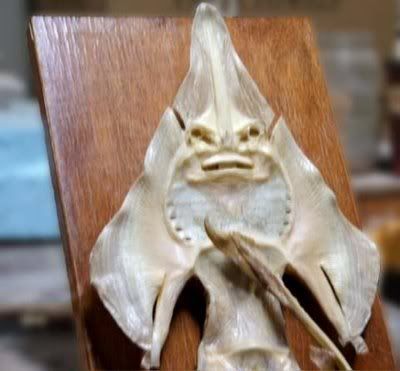
The photo above is a Jenny Haniver.
That's not the name of a person, it's the carcass of a ray or a skate which has been modified and subsequently dried, resulting in a grotesque preserved specimen. [
wiki]
One suggestion for the origin of the term was "jeune d'Anvers" (French for Antwerp is Anvers), that is "young girl of Antwerp." British sailors "cockneyed" this description into the personal name "Jenny Hanvers."
For centuries, sailors sat on the Antwerp docks and carved these "mermaids" out of dried cuttlefish. They then preserved them further with a coat of varnish. They supported themselves by selling their artistic creations to working sailors as well as to tourists visiting the docks.
Jenny Hanivers have been created to look like devils, angels and dragons.
It is possible that Jenny Hanivers were the source of some tales of dragons during the Middle Ages, and they affirmed people's belief in dragons. Jenny Hanivers may also have started the legends of Mermaids.
(via
Cynical-C)
At
Susology, the story of an artist currently creating Jenny Hanivers.
Photo credit:
Awkward Conversations post on "Rogue Taxidermy: The Jenny Haniver".

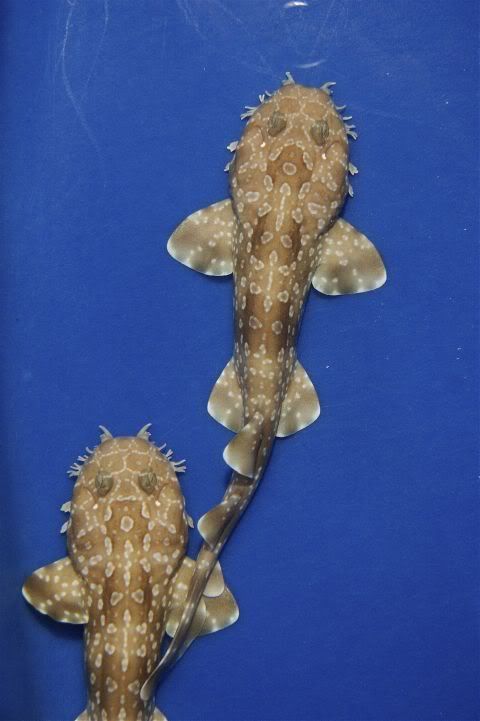
A funky, psychedelic fish that bounces on the ocean floor like a rubber ball has been classified as a new species, a scientific journal reported. The frogfish — which has a swirl of tan and peach zebra stripes that extend from its aqua eyes to its tail — was initially discovered by scuba diving instructors working for a tour operator a year ago in shallow waters off Ambon island in eastern Indonesia.
Each time the fish strike the seabed, they push off with their fins and expel water from tiny gill openings to jet themselves forward. That, and an off-centered tail, causes them to bounce around in a bizarre, chaotic manner.
Photo credit: David Hall
Source


A synthetic "chemical sex smell" could help rid North America's Great Lakes of a devastating pest, scientists say.
US researchers deployed a laboratory version of a male sea lamprey pheromone to trick ovulating females into swimming upstream into traps.
The sea lamprey, sometimes dubbed the "vampire fish", has parasitised native species of the Great Lakes since its accidental introduction in the 1800s.
The sea lamprey's natural life cycle takes it from birth in a stream to adulthood in the ocean, where it gains its vampirical appellation.
Circular jaws lock on to another, larger fish, and a sharp tongue carves through its scales.
From then on the lamprey feeds on the blood and body fluids of its temporary host, often killing it in the process.
Eventually, the satiated lampreys - both males and females - find a suitable stream to swim up, breed and die.
Unlike salmon, which seek out the stream they were born in, lampreys appear willing to take any stream indicating a suitable breeding place; and perhaps pheromones play a role in identifying streams worth selecting.
Source:
BBC

This photo of a Giant frogfish - Antennarius commerson (commersonii) is from
the Frog Fish website by Teresa Zubi

The brownsnout spookfish has been known for 120 years, but no live specimen had ever been captured.
Last year, one was caught off Tonga, by scientists from Tuebingen University, Germany.
Tests confirmed the fish is the first vertebrate known to have developed mirrors to focus light into its eyes, the team reports in Current Biology.
"In nearly 500 million years of vertebrate evolution, and many thousands of vertebrate species living and dead, this is the only one known to have solved the fundamental optical problem faced by all eyes - how to make an image - using a mirror," said Professor Julian Partridge, of Bristol University, who conducted the tests.
Source:
BBC

Glass Fish Bowl - Medium
$59.99 at
Target (available online only)
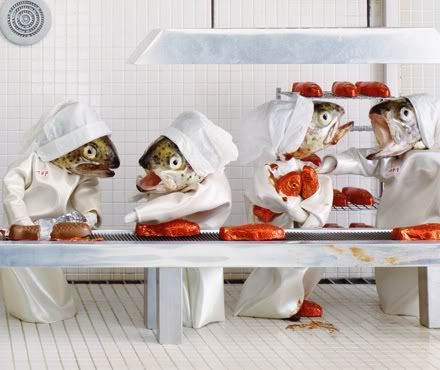
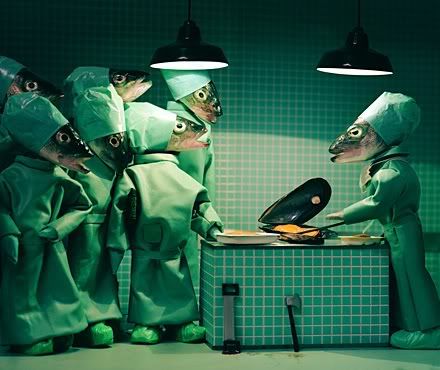
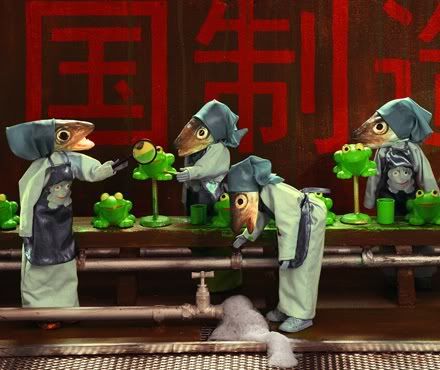
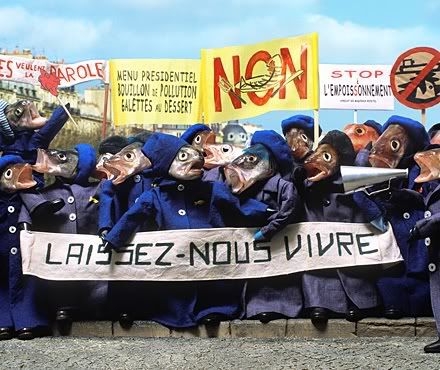
The studio of artist Anne-Catherine Becker-Echivard must smell pretty disgusting.
The Frenchwoman uses fish heads on models to address topics ranging from Aids to repression.
'Fish are a great method of communicating my opinions on this world,' says the 37-year-old, who lives in Berlin.
Since she fell in love with the humble mackerel and sardine 11 years ago, Ms Becker-Echivard has gone on to create a school of art that has left critics open-mouthed.


Source:
Metro

Photo credit: Dr. Scott M. Lieberman - AP

Texas death row inmate Gene Hathorn, who was convicted of killing his father, step-mother and half brother in 1984, has agreed to give his body to Danish based artist Marco Evaristti, for use in an art installation. Mr. Evaristti plans to freeze Mr. Hathorn's body and then turn it into fish food.
Visitors to the as yet unnamed venue would then be able to feed Mr. Hathorn's remains to hundreds of goldfish in a giant aquarium.
This isn't the first somewhat unusual project for Mr. Evaristti. In 2000 he placed goldfish in an electric blender at a Danish art museum, giving visitors the option of turning the machine on and killing the fish. Last year, he also held a dinner party where the main course consisted of meatballs partly made with fat removed from his own body by liposuction.
Source:
Dallas News

The Georgia Aquarium is now home to the only manta ray on exhibit in the United States. The ray, named Nandi, was rescued from shark nets along the South African coast last year.
Most aquariums can't house a manta ray because of how large the animal gets -- up to 26 feet across and weighing about 6,000 pounds. The graceful animal is the largest of the rays.
But the Georgia Aquarium's 6.3 million-gallon salt water exhibit has plenty room for Nandi, who is about 9 feet from the tip of 1 wing to the other and still growing.
Aquarium spokesman Dave Santucci said Nandi had outgrown her home in South Africa, and the Georgia Aquarium jumped at the rare chance to exhibit a manta ray.
Nandi was released into the aquarium's enormous Ocean Voyager tank on Friday and has her official public debut today.
Manta rays are listed as a threatened species. The mammoth diamond-shaped animal has a black top and white bottom with wings that move gracefully up and down as they swim through the water.
Just three other countries house manta rays at aquariums: Japan, Spain and the Bahamas.
Source:
Live5News.comPhoto credit: John Bazemore / AP

When Peter Hodge learned he had terminal motor neurone disease, he requested his remains be mixed in with the special groundbait he used to catch fish in his local river.
The 61-year-old, from Puriton, near Bridgewater in Somerset said he wanted to swim with his favorite fish in the spot where he spent 40 happy years angling.
After his death last month he was cremated in a wicker fishing basket coffin, and his ashes were mingled with 30lb of fish food.
"He wanted the fish to gobble him up so he could swim up and down the river after his death."
Source:
Telegraph

A cute little cartoon fish is one of the mascots for the Beijing Olympics.
But this sick tourist trinket shows a shocking contempt for the creatures – with a live goldfish stuffed into a tiny plastic bag on a keyring.
The bag is sealed so there is only enough oxygen to last for a few hours at the most. Then the goldfish will simply suffocate.
The keyrings – aimed predominantly at children – are already selling fast in markets in Qingdao, the city that will host the sailing events for this summer’s Games.
(via
Critter News)

When sonar surveys spotted a vast pile of rubble in the Columbia River below Bonneville Dam late last winter, officials suddenly worried part of the dam structure was eroding into the river.
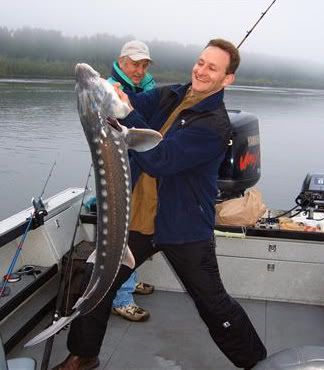
What they found below the spillways in February was not a giant pile of rock at all, but a humongous pile of thousands upon thousands of sturgeon - some of them 14 feet long or longer - lounging together in frigid water at the bottom of the river.
The mountain of white sturgeon contained around 60,000 fish, according to a crude estimate by Michael Parsley, a research fisheries biologist with the U.S. Geological Survey's Columbia River Research Laboratory in Cook, Wash. He described that estimate as "probably conservative."
It was an aquatic phenomenon nobody had ever seen at such a monstrous scale, offering a startling glimpse into the life of the Columbia's largest and most ancient fish.
Source:
Oregon LivePhoto:
Columbia River Trophy Sturgeon Fishing
 Photograph by Michael McEvoy, DEEP Indonesia/Barcroft/Fame Pictures
 The photo above is a Jenny Haniver.
 When sonar surveys spotted a vast pile of rubble in the Columbia River below Bonneville Dam late last winter, officials suddenly worried part of the dam structure was eroding into the river.