Over six decades at Harvard University he has discovered more about ants than anyone else in history. He has thrown into relief for the general public just how important ants are—how they represent 25% or more of the insect biomass on the planet, how collectively they weigh more than all the humans in the world, how they assist humans by aerating the soil, suturing wounds, or, as in South Africa, harvesting the rooibos seeds for farm workers to collect. And how ancient they are: in 1966 Wilson and his colleagues identified an ant in a shard of amber that was 80m years old. Ants emerged along with flowering plants 130m years ago. By contrast, the genus Homo diverged 2m years ago, has existed as Homo sapiens for a fraction of that time, with a civilization of 20,000 years or so.
The mountains of southeastern Arizona have been a favorite collecting site for lepidopterists for generations. Yet new species continue to be described at the rate of about three per year.
One of the latest discoveries is the largest member of the genus Lithophane, a group of particularly large and beautifully coloured moths. Lithophane leeae has a forewing length 25% larger than the previous record, measuring 25mm, and more extensive and brighter pink coloration. So far known from a single female collected at 7,700ft elevation in mid-June in the Chiricahua Mountains, this species is predicted to feed on pine, like related species.
This picture of a garden tiger moth (Arctia caja) was taken in Amersham, Buckinghamshire. The caterpillars of this moth feed on nettles, so if you want these moths to be a feature in your garden, then keep a rough, uncultivated patch
What's that buzzing in your ears? A fly, you say? It's true--these unique ear buds actually look like flies! Compatible ear buds to most MP3 players, portable gaming systems and laptops will help drown out the outside noise of everyday life. Accessorize your ears! Fly Ear Buds include 2 sets of silicone tips, one small and one large.
The diversity of insects on this planet is astonishing and should be a source of continual wonder for us all. It can only be hope that these incredible creatures can be left to survive and continue their species for many millennia to come. Of course they do everything we do - sometimes with much more aplomb!
Thailand's self-proclaimed "Scorpion Queen" created a new world record Monday by holding a live seven-inch scorpion in her mouth for more than two minutes.
She held the poisonous arachnid in her mouth for two minutes and three seconds before spitting it out -- all the time wearing a white dress and gloves covered in the stinging creatures.
On the side of a mountain on the outskirts of Montana’s capital city, loggers are racing against a beetle grub the size of a grain of rice.
From New Mexico to British Columbia, the region’s signature pine forests are succumbing to a huge infestation of mountain pine beetles that are turning a blanket of green forest into a blanket of rust red. Montana has lost a million acres of trees to the beetles, and in northern Colorado and southern Wyoming the situation is worse.
The black, hard-shelled beetle, the size of a fingertip, drills through pine bark and digs a gallery in the wood where it lays its eggs. When the larvae hatch under the bark, they eat the sweet, rich cambium layer that provides nutrients to the tree. They also inject a fungus to stop the tree from moving sap, which could drown the larvae. That fungus stains the wood blue.
“The Latin name is Dendroctunus, which means tree killer,” said Gregg DeNitto, a Forest Service entomologist in Missoula, Mont. “They are very effective.”
Scientists have found a previously unknown population of vampire moths that may have evolved from a fruit-eating species.
Only slight variations in wing patterns distinguish the Russian population from a widely distributed moth species, Calyptra thalictri, in Central and Southern Europe known to feed only on fruit.
There are 11 species of giant weta. The largest species of giant weta is the Little Barrier Island giant weta also known as the wetapunga. They are found primarily on New Zealand offshore islands, having been almost exterminated on the mainland islands by introduced mammalian pests.
Thanks goodness, the Giant weta prefers a vegetarian diet. Still, I wouldn't want to meet one.
There's a series of photos from the Cairns Post, which show a giant Golden Orb Weaver spider who caught a chestnut-breasted mannikin bird in its web. The photos were snapped in a backyard in Cairns, Queensland, Australia.
Joel Shakespeare, the head spider keeper at NSW's Australian Reptile Park, said he had seen golden orb weaver spiders as big as a human hand but the northern species in tropical areas were known to grow larger.
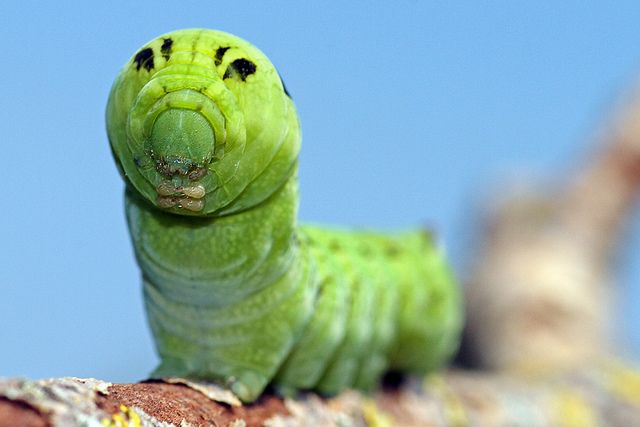
"There once was an ugly duckling," goes the old song. This could not be more true of these stunning butterflies and their most peculiar caterpillars. Another opportunity to scratch your head at the vagaries of Mother Nature, take a look at this pictorial proof of butterfly beauty and caterpillar creepiness!
Most people know that bees, wasps, hornets and some ants can sting to defend themselves or their nests. Only a few people realize, usually from first hand experience, that handling some caterpillars can produce some painful results.
Stinging caterpillars possess hollow quill-like hairs, connected to poison sacs, that are used as defensive weapons. When these hairs are touched they break through the skin releasing the poison. Reactions can range from a mild itching to the more severe pain, dermatitis, and even intestinal disturbances.
Most encounters with stinging caterpillars result from accidentally brushing against leaves on which they are feeding. Don't brush it off or slap it with a bare hand. Use a stick or other object to remove it carefully. Hollow spines may break off in clothing or gloves.
No really effective home first aid treatments for caterpillar stings are available. Adhesive tape or transparent tape may be used to pull out some of the broken spines in the sting area. Washing the area thoroughly with soap and water may help remove some of the irritating venom. Prompt application of an ice pack or baking soda may help to reduce pain and prevent swelling. Antihistaminic drugs, often administered for bee and wasp stings, are reportedly ineffective. See a physician if severe reactions occur. Very young, aged or persons in poor health are more likely to suffer severe reaction symptoms.
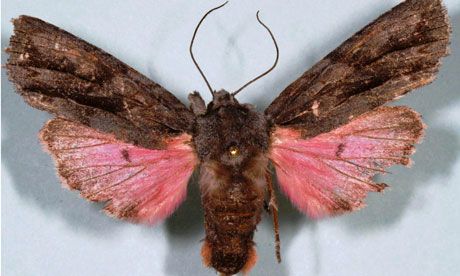 The mountains of southeastern Arizona have been a favorite collecting site for lepidopterists for generations. Yet new species continue to be described at the rate of about three per year.
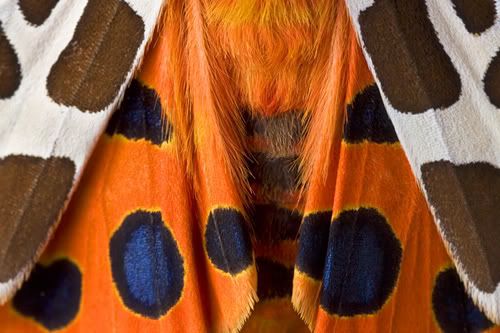 Garden tiger moth close-up by Paul Keene
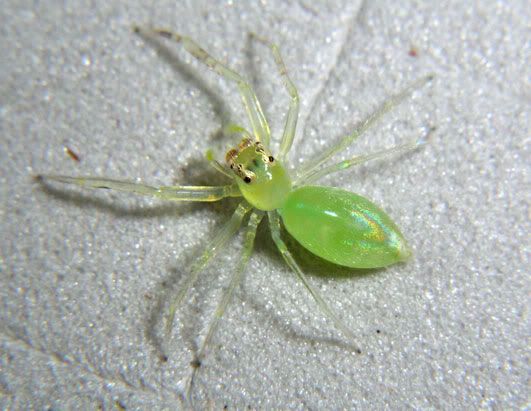 This new jumping spider species, Orthrus sp., was found in a Papua-New Guinea rainforest during the 2008 expedition.
 The Very Hungry Caterpillar Cupcake Party Train by Lyndsay of Coco Cake Cupcakes.
 The diversity of insects on this planet is astonishing and should be a source of continual wonder for us all. It can only be hope that these incredible creatures can be left to survive and continue their species for many millennia to come. Of course they do everything we do - sometimes with much more aplomb!
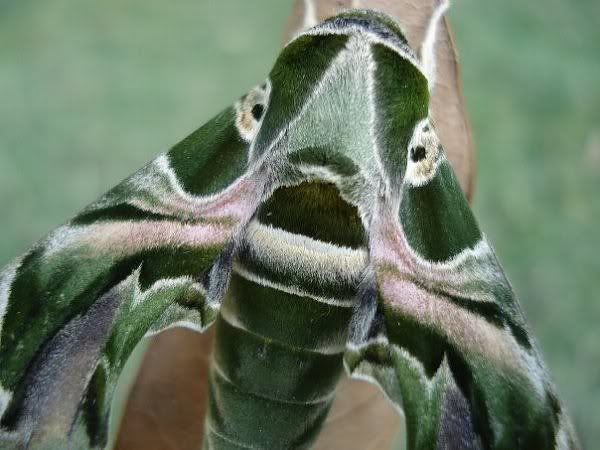 Image: aegle~busy shifting
 Thailand's self-proclaimed "Scorpion Queen" created a new world record Monday by holding a live seven-inch scorpion in her mouth for more than two minutes.
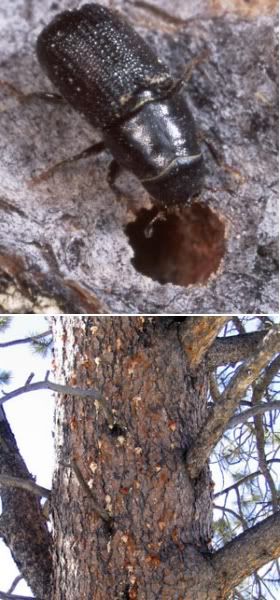 On the side of a mountain on the outskirts of Montana’s capital city, loggers are racing against a beetle grub the size of a grain of rice.
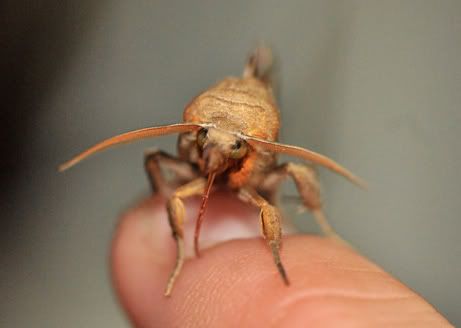 Scientists have found a previously unknown population of vampire moths that may have evolved from a fruit-eating species.
 6th Place, 2008 Nikon Small World Photography Contest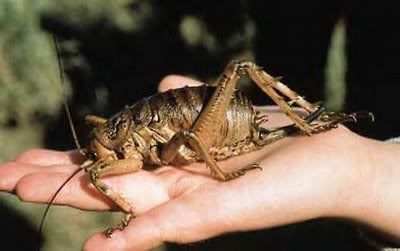
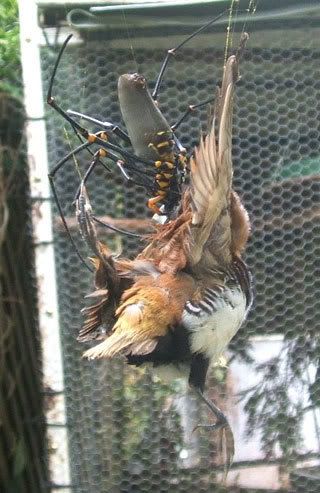 There's a series of photos from the Cairns Post, which show a giant Golden Orb Weaver spider who caught a chestnut-breasted mannikin bird in its web. The photos were snapped in a backyard in Cairns, Queensland, Australia.
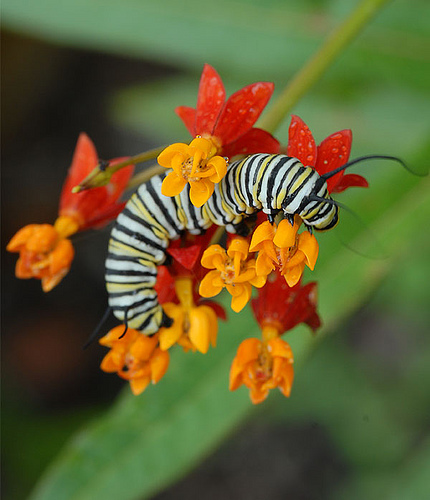 "There once was an ugly duckling," goes the old song. This could not be more true of these stunning butterflies and their most peculiar caterpillars. Another opportunity to scratch your head at the vagaries of Mother Nature, take a look at this pictorial proof of butterfly beauty and caterpillar creepiness!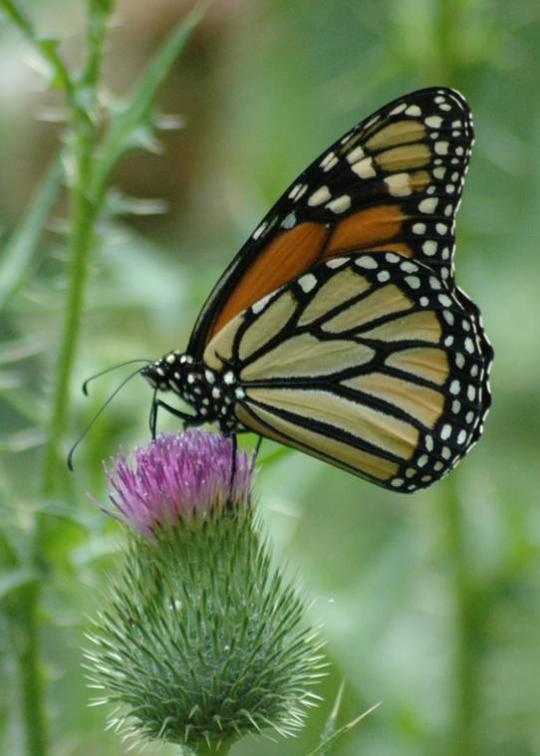
 Most people know that bees, wasps, hornets and some ants can sting to defend themselves or their nests. Only a few people realize, usually from first hand experience, that handling some caterpillars can produce some painful results.