In the end, Hannibal did not administer the fatal bite to his mate's neck. And Jao Chu did not immediately kill their offspring, as is often the case.
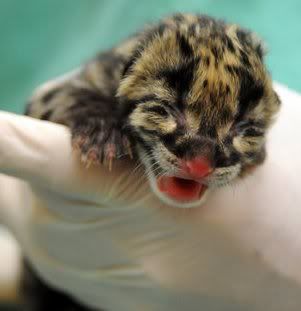
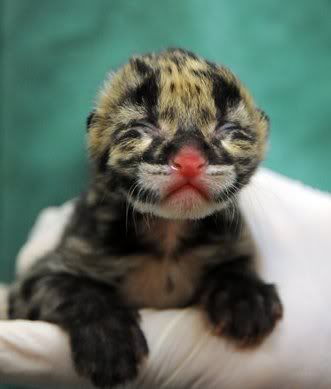
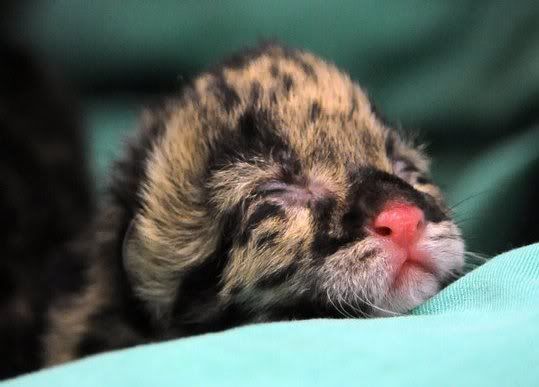
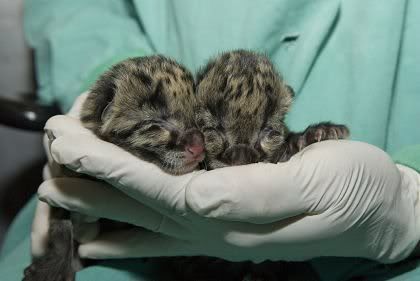
And so, early yesterday, despite murderous tendencies in the captive species, two newborn clouded leopard cubs were found alive, well and squealing at the National Zoo's Conservation and Research Center in Front Royal, Va.
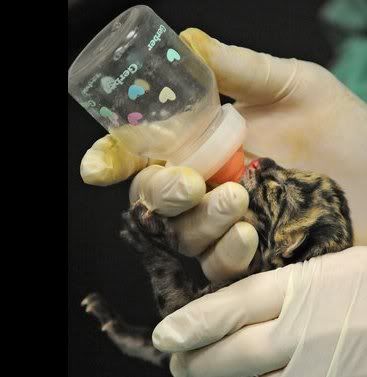
They were taken immediately from their gorgeous mother before she could do them harm, or do them in, placed in an incubator set at 88 degrees and fed salt water from baby bottles. Born with dappled, reptile-pattern fur, they were the first such births at the zoo in 16 years.
Their births were a coup, and the end of a complex reproduction saga involving an exotic, endangered and beautiful species of animal that experts call the ghost cat.
It was also a genetic home run: The zoo said the cubs' genes, which come from outside the captive population, make them among the most valuable clouded leopards in North America.
SourcePhoto credit: Tracy A Woodward-The Washington Post

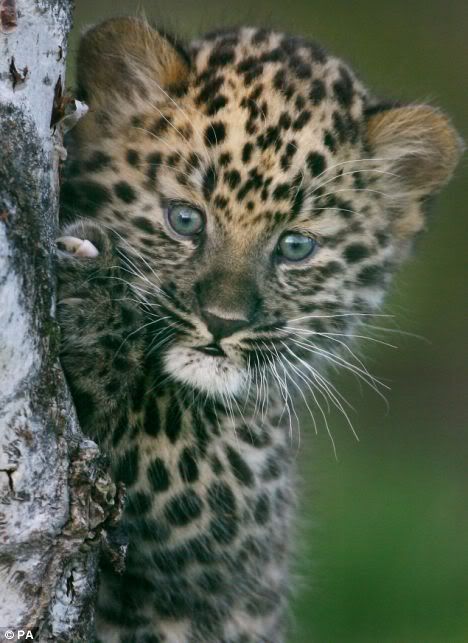
8-week old Amur leopard at the Wildlife Heritage Foundation (WHF), a conservation charity based in Smarden, Kent

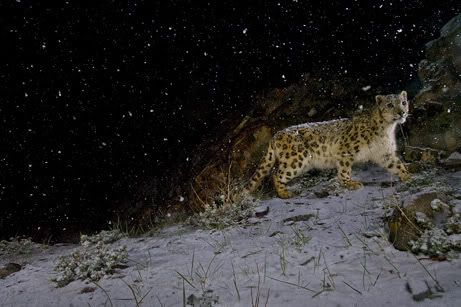
Stalking India's Hemis National Park, a snow leopard lives up to its name in U.S. photographer Steve Winter's award-winning National Geographic magazine image.
On October 30, 2008, "Snowstorm Leopard" was named best overall photo in the 2008 Wildlife Photographer of the Year competition, which is organized by the Natural History of London and BBC Wildlife Magazine.
As few as 3,500 snow leopards remain in the wild.
(
See more snow leopard photos by Winter.)
Source:
National Geographic

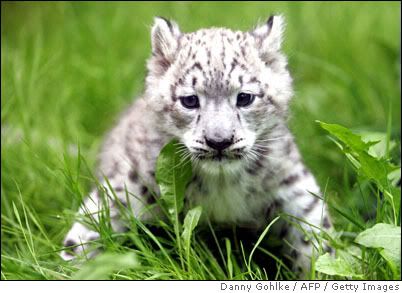
Three-month-old snow leopard Emba at the zoo in Rostock, Germany.

This fourteen-week-old baby Amur leopard already has a fearsome set of fangs. As a member of the world's rarest big cat species, she is bound to become the star attraction at Marwell Zoo in Hampshire.
But with the wild population said to be as little as 35, her real significance is to conservationists.
Only half a dozen Amurs left in their native habitat on Siberia's Pacific coast near the Korean border are thought to be females.
Source:
the Daily Mail

Persian leopard triplets born in June were presented Tuesday at the Budapest Zoo. The cubs—a male and two females—were born at the zoo on June 19 and are doing well, said zoo spokesman Zoltan Hanga.
The Persian leopard is the largest of the leopard subspecies and is native to Western Asian countries such as Iraq, Afghanistan and Armenia.
The leopard is endangered, however, with less than 2,000 thought to be living in the wild. An additional 74 leopards live in zoos.
The cubs born in Hungary—sisters Bella and Bara and brother Bahar—are part of a breeding program of the European Association of Zoos and Aquaria.

Hunters in Russia's Far East have shot and killed one of the last seven surviving female Amur leopards living in the wild, WWF said on Monday, driving the species even closer to extinction.
Last week environmentalists said there were only between 25 and 34 Amur leopards -- described as one of the most graceful cats in the world -- still living in the wild. (
Full story)
"Leopard murder can only be provoked by cowardice or stupidity, in this case most likely by both," Pavel Fomenko, WWF's biodiversity coordinator in Russia's Far East said in a statement.
A hunter shot the leopard through the tail bone. It tumbled over and was then beaten over the head with a heavy object, WWF said. Amur leopards have not been know to attack humans.