Biologist Tovi Anderson of Stanford University and her team compared the genes of wolves from Yellowstone National Park and the Canadian Arctic to those of domestic dogs and coyotes. They found that, in each species, the black individuals have the same mutation, which first arose about 45,000 years ago. And molecular-clock analysis showed the mutation was oldest in dogs, suggesting it originated with them and then spread to wolves and coyotes through interbreeding.
This all happened in North America, because there are no black wolves in Europe or Asia (except for an Italian population that has hybridized very recently with dogs). And wolves picked up the black-coat mutation in the distant past, perhaps 12,000-15,000 years ago, when people first crossed the Bering Land Bridge from Asia.
The black coat seems to provide an advantage to forest-dwelling wolves, meaning dogs passed on some useful genetic diversity to their wild cousins.
Source

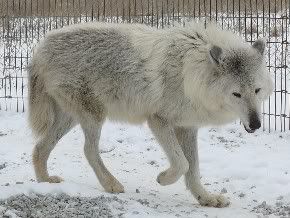
Little Odin was born in the spring of 1994. He is the grandson of the original "Odin", who was the largest known captive wolf in North America.
Little Odin is a British Columbian wolf. British Columbian wolves are primarily black, however Little Odin has grayed out tremendously since he is getting up in age.
Weighing approximately 130 pounds, Little Odin is and has always been the true star of Big Run's presentations!
Beginning as a one-month old pup, Little Odin has helped educate thousands of people and has no less than 650,000 miles under his paws, going to schools, libraries, etc. He is extremely well-behaved, even among crowds. Being semi-retired now, when he stands at the gate and wags his tail, he’s saying that he would like to go to the program that day.
Little Odin lives at
Big Run Wolf Ranch in Lockport, IL. Big Run Wolf Ranch is a federally licensed non-profit educational facility specializing in North American wildlife. They have been licensed for approximately 20 years and doing educational lectures for approximately 14 years.
Many of the animals at Big Run have been rescued wherein the only other alternative was euthanasia. Although they have rescued many animals, Big Run's primary objective is education. Currently, they are unable to comfortably house any additional wildlife. They are in the preliminary stages of planning a larger facility to provide homes for orphaned wildlife. Plans include an on-site rehab medical facility as well as an 1800 sq. ft. on-site education center.

More gray wolves mean more pronghorn antelope in the Yellowstone area, according to researchers who say the region's rebounding wolf population is killing and scaring off coyotes that otherwise prey on pronghorn.
The researchers said that during a three-year study, pronghorn fawns were three times more likely to survive in areas dominated by wolves versus those ruled by coyotes. That's because wolves favor larger prey, such as elk or cattle, and generally leave pronghorn alone.
Source:
National Geographic

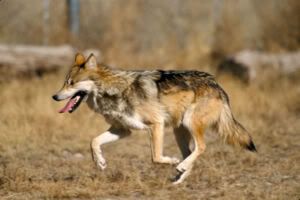
A captive Mexican Wolf (Canis lupus baileyi) at the Sevilleta National Wildlife Refuge, New Mexico, USA. This critically endangered subspecies of the Gray Wolf once ranged from central Mexico to the Southwestern United States. In 1980, the last five known surviving members were captured to save the species. Now, over 300 wolves are taking part in a wolf reintroduction program, with at least fifty individuals in the wild.
Photo credit: Jim Clark, USFWS
(
via)
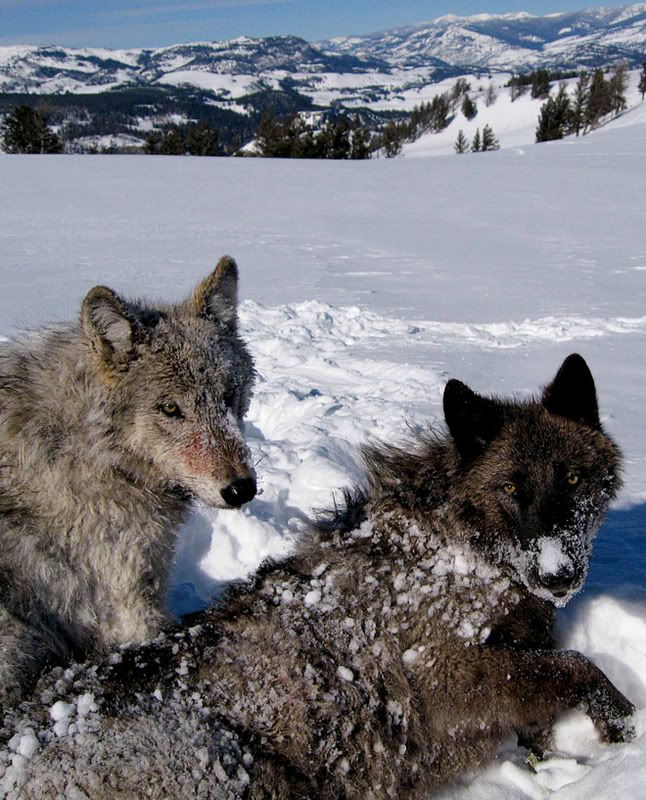 Biologist Tovi Anderson of Stanford University and her team compared the genes of wolves from Yellowstone National Park and the Canadian Arctic to those of domestic dogs and coyotes. They found that, in each species, the black individuals have the same mutation, which first arose about 45,000 years ago. And molecular-clock analysis showed the mutation was oldest in dogs, suggesting it originated with them and then spread to wolves and coyotes through interbreeding.